Monday, 20 January 2014

Forming Ideas...

As my work has begun to develop, I have decided to aim my work in the direction that will aim towards a gallery-situated outcome. I decided to work towards a gallery-situated outcome because it allows me with the space needed to work on a much larger scale, it would also be the right setting for my work to be admired and appreciated by a variety of people.

I would like to produce an installation that will be consistently made up from the geometric forms that I have been working on. The geometric 3-d shapes will include my natural forms through the method of either laser cutting or print, as this is my specialism.

I want my installation to represent 'man made harnessing nature' instead of what is perceived as the human kind causing damage resulting in climate change. As the climate shifts, damage is being create upon the natural environment and through my method of laser cutting or print, I want to capture aspects of nature that are being damaged or overlooked and present them in a manmade setting that is consistent and would always be protected.

I know that my final piece that my Unit X will work towards creating an area that could possibly be walked under, it will consist of my geometric shapes, made from a transparent material combined with my digital drawings of natural forms. The shape and presentation of the outcome that I should be working towards is so far difficult to achieve, I began looking for inspiration through other artists work and their presentation of it as a way of generating ideas that I could then interpret myself.

Cerith Wyn Evans work is the inspiration for this idea. From the use of the bright light appears an uplifting, angelic and beautiful presence however, the glowing columns create presence by the sheer heat they project across the room, creating an unbearable heated atmosphere that can be 'deeply unpleasant'. Evans uses heat to portray the 'rage of desire', in opposition to the cool embrace given from upstairs, giving me a representation of heaven and hell. The simple presentation of columns is what I admire about this work; I wanted to visit the idea of using columns in my work through this drawing. I like the combination of columns alongside individually stacking my geometric cubes. I chosen to work with cubes for this design because of the simplicity they offer in being a even 6-sided shape, the natural forms would provide the detail.


Even though the stacked columns would provide me with a simple and elegant presentation, I want to produce a presentation that has more to offer within its construction. Jim Campbell in his work 'Exploded View (Commuters)', 2001 offers an idea on how to do this. I have kept the idea of using multiples in the back of my mind and this is where it came through, I like the concept of using multiples of one geometric shape all brought together to form the same shape but on a much larger scale, similar to that of Campbell's work presented below. The construction of a piece like this is difficult but the result would be worthwhile, the precision needed for this construction is what would represent the 'order' within my theme. For ideas like this to visualise, I need to work on the technical side of my shapes and how I would incorporate my natural from drawings on them i.e. print.  


Thursday, 16 January 2014

Experimentation- Laser Engraving...

Firstly, I wanted to experiment with engraving my designs of natural forms onto acetate because it so far had proved to be a positive and prospective material to use. However, my first attempt failed, I finished with a pile of burnt acetate because the laser did not engrave, it laser cut straight through the material because of the measurements I had applied to the setting. From this, I reset the settings, which resulted in a successful outcome, I did manage to engrave one of my natural form designs onto acetate, however the result was not as good as expected. The engraved design in some light is barely visible which was extremely disappointing as using acetate these were the either two ways the result was going to result in, both not promising outcomes.


As engraving onto acetate was unsuccessful, I decided to experiment with transparent plastics once again. The strength and thickness of the plastic worked better when engraving into it but the material itself lacks the fluidity that made acetate successful for working towards and creating 3-dimensional forms. Presently, material choice needs further consideration.


 I want my material to hold the specific elements of transparency, slight fluidity for bending and can be engraved or printed on.
  

A New Technique...

After going into tutorial with ideas of visualisations and prospective outcome ideas, it was suggested that I look at other sources of materials that could work better on a larger scale. Acetate works on a small scale and in multiples as a way of sampling but now, my visualisations are on a much larger scale than originally thought, material choice is becoming a prominent issue to consider. As my theme is of 'Order and Chaos', I decided to experiment with using the laser cutter in order to create specific measured shapes that I could then experiment with and represent the 'order' within my theme. 

I also wanted to use the laser cutter as another form of method to apply my drawings onto a material. Using the laser cutter also allows me to experiment broadly with material choice because the laser cutter can cut through most materials; it gives me extra room to explore. I find using computer applications difficult so using Illustrator to put my designs through to the laser cutter was a time-consuming process. After playing around with Illustrator, I created files that were successfully used on the laser cutter, these files produced simple cut shapes that were all sized consistently, and I even engraved into wood and plastic.


I did chose to work mainly with transparent materials such as Perspex and plastic because I wanted to carry on with the aspect of looking through what is created. I began experimenting with creating different forms and shapes from the laser cut pieces, working without a specific precision
or outcome is hard for me. I created some small-scale triangle pieces that do not fit precisely together but this works for the outcome, they are raw and interesting; I love the pieces when light flickers of them, and they remind me of diamonds. On a large scale, I would prefer these triangles to perfectly slot together to portray the 'Order' within my theme, I also would like my drawings to be placed on the material through the technique choice of laser engraving which would need testing and this is where my next step will begin.


Integrating the spider web form into my 3-d geometric shapes...

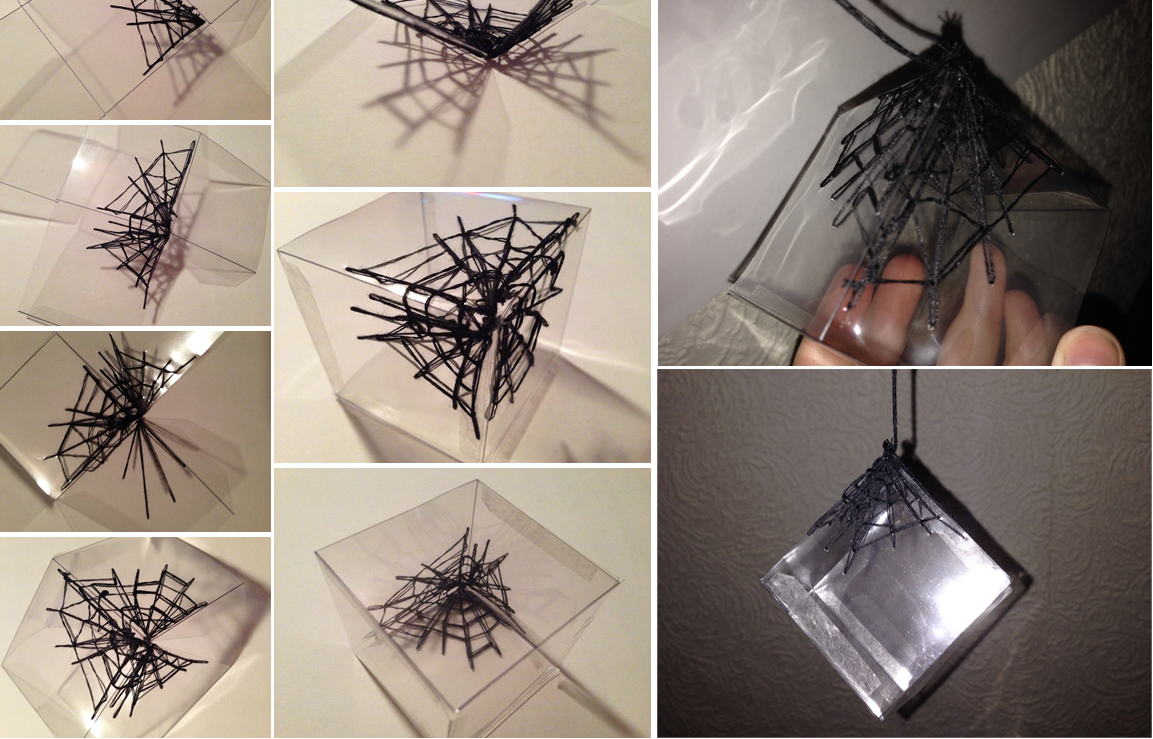
After looking at Tomas Saraceno's work and deciding that I want to integrate the spider web form into my 3-d geometric shapes that I have been creating, I started to experiment with this idea by sewing the spider web form directly onto them. The sample created is sewn on a clear acetate box that does not have any of my drawings printed on them so it does work well, however, if I did this web onto a 3-d container that has my drawing already printed on them, I do not think the combination of the two would work. The combination of the two may be too chaotic and distracting to one another that I would maybe consider using the spider web form differently.


I have been making individual containers that differ in size, shape and pattern but have always kept the vision of working with them in multiples in the back of my mind because I think near to the end; this is where my ideas will lean towards. I began to consider using the spider web form as a way of connecting a collection of these containers together to form an installation or maybe a gallery situated piece. I used the spider web form previously created and hung one singular container from it, this itself pulled the web heavily down, making me consider whether the idea of multiples being presented the same way would work. For this to be a reasonable outcome, I would have to put major reconsideration into material choice and scale.

I did begin to look at other alternative sources of materials that could make an interesting web but the outcome was not as expected. As I have said I wanted to become more free and loose with the web form, I decided that hot glue draping into the form of a spider web could create an interesting outcome. The decision to use hot glue to drape came from the work created and produced by Yasuaki Onishi. Titled, 'Vertical Emptiness', the outcome is purely beautiful. However, my outcome failed, the glue did not drape as intended, nor connect together, and I just ended up with clumps of glue sporadically positioned. I did find that the glue reflected shadows that could easily portray clear visible imagery around a room.


Natural form- Spiderwebbs/ Tomas Saraceno's Inspiration...

The spider web form was explored at the beginning of the research stage but it was overlooked during the sampling stage because I quickly moved on towards shells. I wanted to begin exploring the spider web form again but in more depth because after being recommended to look at Tomas Saraceno's work, I thought I had dismissed it too quickly. Digitally drawing spider webs are visually pleasing, they hold pattern and fits perfectly in my theme of 'Order and Chaos' as my digital drawings portray chaotic designs that holds the aspect of order within the spider webs construction, each web is connected together.


Using my drawings, I wanted to create a tactile version of a spider web, I decided to use black cotton thread as my only source of material for this sample because it is a flexible material to work with, it is thin and most resembles the qualities found in spider webs, the cotton also allows room for manipulation and control. I hand tied strings of thread to reach to this sample below. It was time-consuming but the photographs are worthwhile, they demonstrate a clear with my theme of 'Nature vs. Manmade'. Some of my photographs are exciting to look at because I do think they resemble what they were clearly inspired by.
 

Improving this sample and taking the spider web form further, I would experiment with the idea of threads alongside vanishing film in order to create larger samples; I predict that it would also give the spider web form created more depth and detail. Using the thread on a loose stitch on a sewing machine would also give me room to become free with what was being designed; I could become more chaotic and free.


Tomas Saraceno's work (above and below) with the spider web form has been a major influence in my working with spider webs; his work is fascinating, beautiful and incredibly detailed. Saraceno derives inspiration for his pieces from all sorts of things such as; soap bubbles, air dust particles and natural forms. Spider webs inspired Saraceno’s work at ‘The Venice Art Biennale, 09’, the scale is colossal and the presentation is simple and elegant, nothing takes away from his work. I admire how Saraceno uses the web to suspend and present his pieces, this inspired me to want to include the spider web form in my work as way of suspending my 3-d geometric forms.


Julia and Mark's Tutorial Notes...


After seeing Julie and her advising me that I need to become more decisive on my context, I began to consider where I actually want to see my work. As I am interested in installations, 3-dimensionality and light, these are the concepts my pieces will involve and work towards. To be decisive, I have decided that my work will be produced with a focused contemporary installation in mind. Maybe a type of light installation that; could become a positioned piece in a gallery space or functionally used as a chandelier of some nature. My theme of ‘Order vs. Chaos’, alongside ‘Nature and Manmade’ will still apply as some of my ideas already produced; inspire aspects that could work on a larger scale to become my intended outcome. After taking a week out of my project because of my essay, looking back through my project after this break gave me prospective on where I want my work to aim.

I was slightly nervous at the prospect of today’s tutorial with Mark. After taking some time away from my project, to complete my first draft of my dissertation, I felt lost with what I was going to continue experimenting with. As seen from my blog and sketchbook, I stopped working with acetate as I felt like I had exhausted all avenues and began working with paper. Using paper is where my original experimentation work started to inspired me to work with acetate, by going back to the start by using paper again; I was hoping it would supply further inspiration as to where my project will continue. I created a few samples from paper but using paper did not supply me with any further ideas, I felt like my work was going backwards instead of improving. I began to go through my sketchbook again to pick out samples that made the most impact and this seemed to help but going into tutorial, I still felt unsure of what my next steps were going to be.

After optional tutors and a dentist appointment, it has been 4 weeks that Mark had not seen my work, so getting his feedback was beneficial. Mark suggests to me that I should read and examine my drawings further as this was where all my experiments were at its highest point, they informed my structural work. As I want to begin working with materials, Mark suggested I experiment with the laser cutting but directly cutting out and engraving into a variety of materials. This is something that has interested me, I have been aware of the laser cutter for a while but I did not feel ready, until now, I am going to begin using some of my existing drawings and experiment with them on the laser cutter and engraver, experimenting with a variety of materials.

As I like the transparency that the acetate has provided, I am going to continue using acetate along with other transparent materials such as plastics and Perspex. I also want to experiment with fabrics but not in as much depth, I just want to experiment with material qualities to find the one that is appropriate for me. I visited Aidan, the laser cutter technician and he was incredibly helpful on where I need to begin with illustrator, time scale for each piece and material sizes for testers. By Monday or Tuesday, I am hoping to have a selective range of illustrator designs, taken from my drawings, which I will then go on to the laser cutter with. From here, I think it will provide me with a lot more ideas on materials, patterns, scale and structure, to experiment with and maybe help produce some visualisations that all lead the correct way.

Paper Light Shade inspired by Thyra Hilden and Pio Diaz...


After deciding to work with paper again, for further inspiration, I re-looked over my project so far, to gather old inspiration that could be explored in more depth. I began experimenting with the pattern that I had come across during research into 'architecture design patterns’; the pattern was constructed and hand carved to add extra detail to the architectural space that it was positioned in.

I wanted to combine this pattern with light and shadow, the two continual themes that have been running throughout my project. I created this sample from paper and as I anticipated, it held structure and the shape aimed for well, the light extracted through the cut pattern clearly, allowing shadows to be portrayed, this pattern did project around a room but not on the scale that I wanted. The nearer the light source and shade is to a surface the clearer the pattern is portrayed, the further it becomes from a surface the more indistinctive and blurry the pattern becomes.
 

The pattern being projected around a room clear is an important aspect of where this sample was aiming towards and because it does not appear clear enough, I am going to have to re-think on how it can be. I think using a thicker material or changing the scale may improve on the projection. I want a clear projection that would be on the same par as that of Thyra Hilden and Pio Diaz’s mystical forest inspired light shade is.